Sorting
Source
Legimi
(6)
Katalog zbiorów
(1)
Form of Work
E-booki
(6)
Książki
(1)
Status
available
(1)
unknown
(1)
Branch
Wypożyczalnia dla Dzieci
(1)
Filia szpitalna
(1)
Author
Dimkovska Lidija
(1)
Farndon John
(1)
Harlamov Sergej
(1)
Limboski Michał
(1)
Maležič Jedrt Lapuh
(1)
Olszewska-Marcinkiewicz Anna
(1)
Zupan Uroš
(1)
Škrjanec Tone
(1)
Year
2020 - 2026
(6)
1990 - 1999
(1)
Country
Poland
(7)
Language
Polish
(7)
Subject
Literatura młodzieżowa angielska
(1)
Pogoda
(1)
7 results Filter
Book
In basket
Pogoda / John Farndon ; tł. Anna Olszewska-Marcinkiewicz. - Bratislava : Slo, cop. 1997. - 59 s. : fot. kolor., rys. ; 20 cm.
(Młodzi Odkrywcy)
Na okł. podtyt. : jak obserwować i zrozumieć zmiany zachodzące w przyrodzie Oryg. : Weather. 1992 Indeks
This item is available in 7 branches. Expand the list to see details.
Wypożyczalnia dla Dzieci
There are copies available to loan: sygn. 55 (2 egz.)
Filia w Kowalewie
All copies are currently unavailable
Filia w Kuczkowie
All copies are currently unavailable
Filia w Piekarzewie
All copies are currently unavailable
Filia w Taczanowie
All copies are currently unavailable
Filia w Zawidowicach
All copies are currently unavailable
Filia szpitalna
Brak informacji o dostępności: sygn. 5 (1 egz.)
E-book
In basket
Reserveleben ist eine mitreisende Geschichte über das Schicksal zweier am Kopf miteinander verwachsener siamesischer Zwillinge mit vielsagenden Namen: Zlata (die Goldene) und Srebra (die Silberne). Im Fokus steht ihr Kampf um Individualität, Privatsphäre und ein voneinander getrenntes Leben. Ihr Drama spielt in der Zeit von 1984 bis 2012 zwischen Skopje und London, umfasst aber auch Geschehnisse, die nicht nur Teil ihrer persönlichen, sondern auch der kollektiven Erinnerung und Geschichte sind. Der von Zlata erzählte Roman beginnt an einem Nachmittag im Juni 1984 in einer Vorstadt von Skopje, wo er im August 2012 auch endet. Die zwei Hauptfiguren spielen mit einer Freundin Wahrsagen: wen sie wo und wann heiraten und wie viele Kinder sie bekommen werden, ob ihr Ehemann arm, reich oder gar ein Milliardär sein wird. Zu Beginn spielen Srebra und Zlata, am Ende Zlatas Tochter Marta und Marija. Der Kreis schließt sich – 28 Jahre Leben, Heranwachsen, Leiden, Lieben und Hassen. Die Trennung der siamesischen Zwillinge fällt mit der Trennung der ehemaligen jugoslawischen Teilrepubliken zusammen. "Reserveleben" ist nicht nur ein Liebes-, sondern auch ein politischer und Geschichtsroman sowohl über die Zeit, in der wir leben, als auch über Menschen, in denen wir uns wiedererkennen.
This item is available online. Expand information to see details.
Dostęp do treści elektronicznej wymaga posiadania kodu dostępu, który można odebrać w bibliotece.
E-book
In basket
Form of Work
This e-book is part of the Ulysses' Shelter project started in 2017 with the objective to build a network of exchange literary residencies aimed at young writers and literary translators. The second stage of Ulysses' Shelter is once again being co-funded by the Creative Europe Programme of the European Union, and coordinated by Croatian publishing house and literary agency Sandorf, with four partners, Literature Across Frontiers and Wales Literature Exchange in Wales, Krokodil in Serbia, Thraka in Greece and Slovene Writers' Association in Slovenia. This e-book represents a cross-section of external and internal events from each young literary creator in the months between August 2020 and the end of 2020. It consists of five chapters, each offering a unique insight into the artists' lives, thinking and fears in the last quarter of 2020, that is, in the year Covid-19 was born. At the end of the book, there is a short reflection by the young literary creators on the guest performances carried out in Ljubljana, Slovenia. Then there is a short presentation of all the literary correspondents.
This item is available online. Expand information to see details.
Dostęp do treści elektronicznej wymaga posiadania kodu dostępu, który można odebrać w bibliotece.
E-book
In basket
„Wieloryby nie kłamią” to zbiór esejów, w których realne miejsca, wydarzenia i melodie stają się punktem wyjścia refleksji nad muzyką, pamięcią, psychologią i duchowością. Wątki autobiograficzne splatają się tu z opowieścią o Polsce i jej mitach,o głosach z dzieciństwa i złudzeniach współczesnej kultury. Co zrobił ślepy Willie Johnson z informacją o zatonięciu Titanica – i jak to się stało, że jego piosenka po wielu latach zainspirowała do grania pewnego chłopaka z zachodniopomorskiego Wałcza? Na czym polega postkolonialna asymilacja kulturowa w muzyce krajów Europy Środkowej? Czy warto szukać muzycznego szczęścia w Berlinie? Oraz jak pogodzić sięz własnym krajem – jako miejscem i jego wyobrażeniem? Michał Limboski (ur. 1984) – autor tekstów, wokalista, gitarzysta i producent muzyczny. Od lat tworzy na pograniczu piosenki autorskiej, rock and rolla i folku.Ta książka to jego literacki debiut – zbiór esejów, w których realne miejsca, wydarzenia i melodie stają się punktem wyjścia do refleksji nad muzyką, pamięcią, psychologią i duchowością.Wątki autobiograficzne splatają się tu z opowieścią o Polsce i jej mitach, o głosach z dzieciństwa i złudzeniach współczesnej kultury. „Wieloryby nie kłamią” to osobista mozaika — nieoczywisty portret mężczyzny i jego epoki.
This item is available online. Expand information to see details.
Dostęp do treści elektronicznej wymaga posiadania kodu dostępu, który można odebrać w bibliotece.
E-book
In basket
This collection of twenty-one short stories, which can also be read as a novel since the tales are connected, is entirely set in a psychiatric institution, where the predominantly first-person narrator is often, in several waves, brought in and hospitalized. As is typical of Lapuh Maležič, the very title of the book is distorted and suggestive, as she hints along with the mental also at strain, difficulty, while flirting with a more established term for members of the heavy metal music subculture. At the forefront of the narrative are, thus, individuals who are problematic – also for themselves, not just for society – and who find themselves in psychiatric treatment. And sometimes it is difficult for them to recall their past transgressions, which require therapy that can be quite radical, violent, leaving visible and psychological traces of submission. Just as radical are the side effects of the powerful antipsychotics to which the subject, the object of this therapy, is subjected in a few of the stories; these are cycles of little deaths, and often violent injections or involuntary taking of pills is described as a way of dying, as a toppling into the abyss, as a temporary shutdown. But the collection also bears the opposite of this weighty and sharp metaphor: it is playful and relaxed in its linguistic movement; often in these stories one sees the ambiguous and the polysemous mixing sublimely and pathetically with the most poignant of refrains and references from mass culture that are evoked by popular songs and references to such mass culture icons as Roberto Benigni or Carlos Castanedo.
This item is available online. Expand information to see details.
Dostęp do treści elektronicznej wymaga posiadania kodu dostępu, który można odebrać w bibliotece.
E-book
In basket
Form of Work
Tone Škrjanec (1953) veröffentlichte 1997 seinen ersten Gedichtband mit dem Titel Blues zamaha (Der Blues des Schwungs), dem noch zehn weitere folgten, der letzte, Nekaj o nas kot živalih (Etwas über uns als Tiere), letztes Jahr. Außerdem gab er zwei Bände mit ausgewählten Gedichten heraus. 2017 erhielt er den Preis Velenjica/Čaša nesmrtnosti (Kelch der Unsterblichkeit) für sein ausgezeichnetes zehnjähriges dichterisches Werk, 2018 wurde sein Band Dihaj (Atme) mit den beiden wichtigsten slowenischen Preisen für Dichtung ausgezeichnet: dem Veronika-Preis und dem Jenko-Preis. Im Ausland erschienen bislang sieben seiner Gedichtbände (in Polen, Bulgarien, den USA, Kroatien), zudem wurden seine Texte in zahlreiche Anthologien im In- und Ausland aufgenommen und in einen großen Teil der Weltsprachen übersetzt. Er veröffentlichte eine CD mit Gedichten und Musik, Lovljenje ritma (Jagd nach dem Rhythmus) und war an zwei weiteren derartigen Kompilationen beteiligt.
This item is available online. Expand information to see details.
Dostęp do treści elektronicznej wymaga posiadania kodu dostępu, który można odebrać w bibliotece.
E-book
In basket
Form of Work
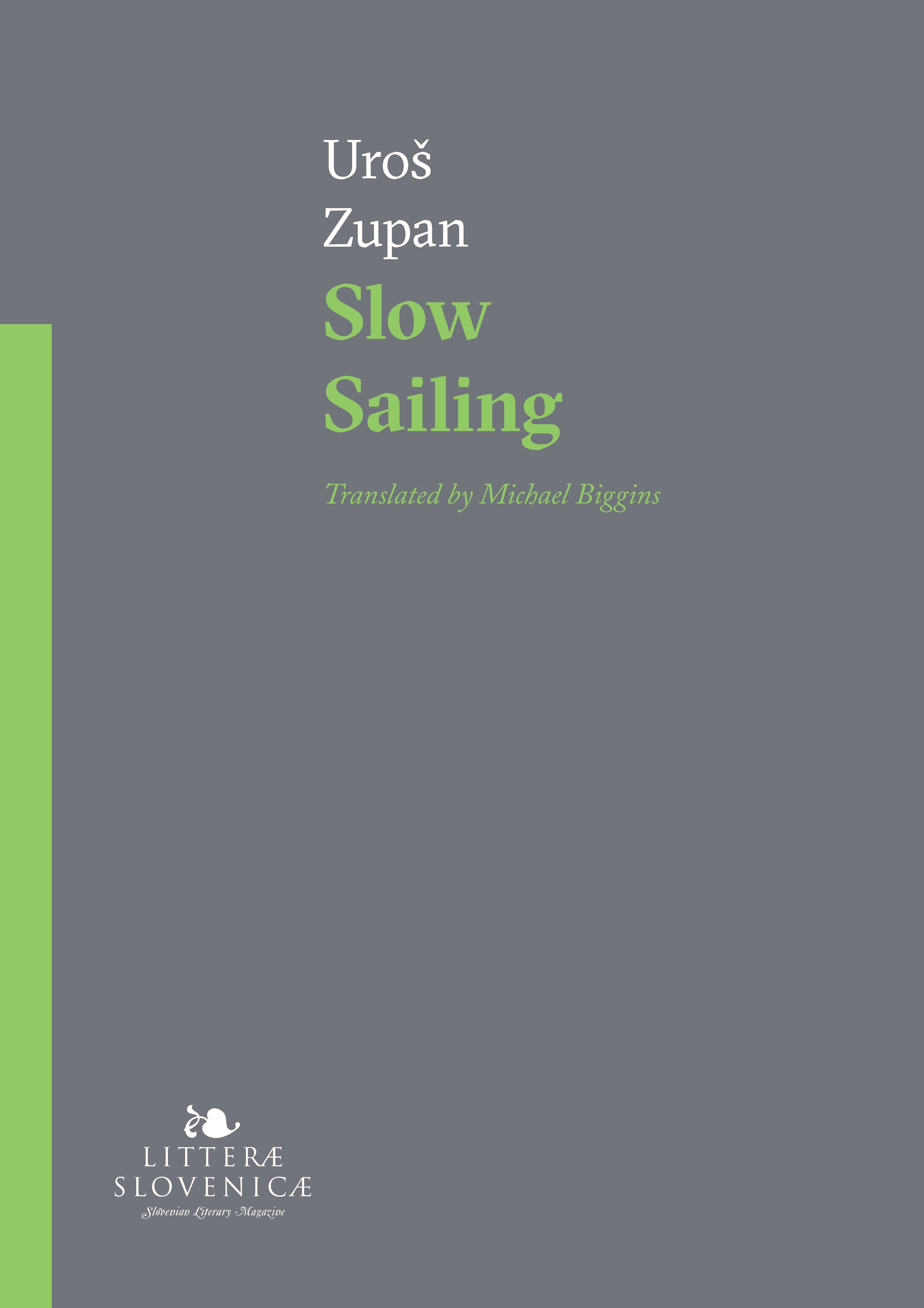
Uroš Zupan (1963) is one of Slovenia's most prominent contemporary poets and he has made his mark on Slovenian poetry of the past 30 years. Slow Sailing presents the author's own selection of the best of his best. This collection, which covers a period of more than two dozen years, is both personal and stern, since the author deals with his own poetry. From his delving into the golden age of his individual past to a sensuous hymn to soft summer light and the miracle of life that does not exist without the arts, Slow Sailing invites us to discover and re-discover one of post-independence Slovenia's most distinctive poetic voices, while also offering a unique insight into Slovenian poetry at the turn of the millennium. The greatest Slovenian poet of the middle generation, his work has not been translated much (and not at all into English); the book is already part of the Slovenian canon and contains Zupan's own selection of his finest poems. He is already included in school literature curricula.
This item is available online. Expand information to see details.
Dostęp do treści elektronicznej wymaga posiadania kodu dostępu, który można odebrać w bibliotece.
The item has been added to the basket. If you don't know what the basket is for, click here for details.
Do not show it again